Small Group Discipleship

Small group discipleship is a relational model of Christian formation where a small, consistent community meets regularly with trained mentors to help individuals grow as followers of Jesus. Through honest conversation, shared spiritual practices, prayer, accountability, and long-term relationships, participants learn to integrate faith into everyday life.

Rather than relying primarily on programs or large events, small group discipleship focuses on consistent community and intentional mentorship, where trust deepens over time and discipleship happens personally, slowly, and relationally. The goal is not simply participation but transformation—forming disciples who live their faith and help others follow Jesus.
LEARN MORE

Why Small Group Discipleship Works

Most ministries are built around programs, events, and content. Those things can gather a crowd, but they rarely create the kind of environment where discipleship actually takes root. Real spiritual growth usually doesn’t happen in large rooms or through one-time experiences. It happens through relationships that develop over time.

Small group discipleship works because it creates a consistent environment where people are known, supported, and challenged in their faith. When the same small community gathers regularly with trusted mentors, something powerful begins to happen: trust grows, honest conversations emerge, and people feel safe enough to explore deeper questions about their relationship with God.  

This kind of environment allows discipleship to move at the pace it naturally requires—slow, personal, and relational. Faith is not just talked about; it is practiced together. Participants pray for one another, share their struggles, encourage spiritual habits, and help each other integrate faith into everyday life. Over time, these ordinary interactions begin to shape how people think, pray, and live as followers of Jesus.

Small group discipleship also creates accountability and consistency. Because the group is small and relationships are ongoing, individuals cannot simply disappear into the background. Each person is known by name, remembered from week to week, and encouraged to continue growing. This sense of belonging is often the catalyst that helps people move from curiosity about faith to a deeper commitment to living as a disciple.

Perhaps most importantly, small group discipleship multiplies. As individuals grow in faith, they naturally begin inviting others into the same journey. New leaders emerge, new groups form, and discipleship spreads through relationships rather than programs. In this way, small group discipleship becomes not just a ministry strategy but a sustainable way of forming disciples who help others follow Jesus.

Intentional Small Groups:
A Model for Small Group Discipleship

While many ministries talk about small group discipleship, the challenge most leaders face is knowing how to structure it in a way that actually works long term. Without a clear model, small groups often become inconsistent, leader-dependent, or focused primarily on content rather than relationships.
Intentional Small Groups provide a practical framework for implementing small group discipleship in a sustainable way.
An Intentional Small Group is a purposefully small community—typically six to eight students—led by trained mentors who meet with the same group consistently over time. Rather than rotating participants or focusing primarily on teaching content, the group is built around two core elements: intentional mentorship and consistent community.  

This structure allows real relationships to form. As the same people gather week after week, trust deepens, stories unfold, and faith becomes something that is lived together rather than simply discussed. In this environment, prayer becomes natural, accountability grows, and discipleship begins to take root in everyday life.  

Intentional Small Groups are designed specifically for individuals who are ready to take the next step in their faith journey—those who are seeking to follow Jesus more intentionally and want a community that will walk with them in that process. Within the group, participants explore questions, develop spiritual habits, and learn to live out their faith alongside others who are pursuing the same goal.  
Over time, this model produces disciples who naturally begin inviting others into the journey. As new leaders are formed and additional groups begin, the ministry grows not because programs expand, but because discipleship multiplies through relationships.  

In this way, Intentional Small Groups are not just another program within a ministry. They are the building block that allows small group discipleship to become a sustainable strategy for forming disciples.
Small group discipleship is the broader ministry philosophy of forming disciples through consistent relationships in small communities.

Intentional Small Groups are the practical model that makes this philosophy sustainable and scalable in parish life.

By combining intentional mentorship with consistent community, the model creates an environment where discipleship can grow naturally over time.

How Intentional Small Groups Work

Intentional Small Groups are designed around a few core practices that allow small group discipleship to move from theory to lived experience. While every group develops its own personality and rhythm, the structure of the model remains consistent. This consistency is what allows relationships to deepen and discipleship to grow over time.

1. Intentional Mentorship

At the heart of every Intentional Small Group are adult mentors who accompany participants on their faith journey. Their role is not simply to teach or deliver content but to walk alongside students, guiding conversations, encouraging spiritual growth, and modeling what it looks like to follow Jesus in everyday life.

Mentors help create a culture of trust and accountability where participants feel safe sharing their questions and experiences.

2. Consistent Community

Intentional Small Groups meet with the same people over a long period of time, often for several years. This long-term consistency allows trust to grow and friendships to develop in ways that are difficult to replicate in larger or constantly changing environments.  As the group gathers week after week, members begin to feel seen, known, and supported.

Stories unfold, questions surface, and the group becomes a place where faith can be explored honestly and authentically.  

3. Purposefully Small

Intentional Small Groups stay intentionally small so that every person can be known. Most groups include six to eight participants and are led by two adult mentors. A group this size allows conversations to go deeper, encourages participation from everyone, and creates an environment where relationships can form naturally.  

When groups remain small, participants are not just attendees—they become active members of a community where their presence matters.

4. Weekly Gatherings

Each Intentional Small Group follows a simple rhythm when they gather. Most groups meet weekly for conversation, prayer, and reflection on life and faith. These gatherings create space for participants to share their experiences, encourage one another, and explore how faith applies to real life.  

Over time, these regular rhythms of conversation, prayer, and encouragement shape the habits that sustain a lifelong faith.

5. Commitment to Growth

Intentional Small Groups often develop shared commitments—sometimes called a rule of life—that help the group practice faith together. These commitments might include regular prayer, participation in the life of the Church, serving others, or supporting one another in spiritual growth.  

These practices are not meant to create pressure but to cultivate a shared rhythm of life that keeps the group moving toward deeper discipleship.

6. Multiplication Through Relationship

Healthy small group discipleship eventually multiplies. As participants grow in their faith, they naturally begin inviting others into the journey. New leaders emerge, new groups form, and the ministry expands through relationships rather than programs.
 
This is what allows the model to scale. Disciples are not only formed within the group—they become the people who help others encounter Christ.

The History of Small
Group Discipleship

Small group discipleship is deeply rooted in Catholic tradition. From the earliest days of the Church, the faithful gathered in small communities—often in homes—to pray, break the bread of the Eucharist, share life, and support one another in missionary discipleship, as seen in the Acts of the Apostles. The early Church met in homes (Acts 2:46), living out faith through fraternal communion, doctrinal formation, and apostolic witness.

This communal model of formation has been continually affirmed throughout the Church’s history. Vatican II highlighted the importance of small groups and lay associations that gather to examine apostolic activity, foster spiritual growth, and integrate the Gospel into everyday life. Popes such as St. John Paul II praised these small Christian communities as a “solid starting point for building a new society,” provided they remain in communion with pastors and the universal Church. More recently, the Synod on Synodality has reaffirmed the importance of small communities and relational accompaniment as essential resources for forming missionary disciples across generations.

At the same time, many parish ministries today struggle to translate this vision into practical structures that can sustainably form disciples. Programs and large events often gather people together, but they rarely provide the consistent relationships necessary for long-term spiritual growth.

To address this challenge, Michael Marchand, founder of ProjectYM, developed the Intentional Small Group Model through years of parish ministry and collaboration with youth ministers across the country. The model provides a practical framework for implementing small group discipleship within parish life by combining two essential elements: intentional mentorship and consistent community.

Intentional Small Groups build on the Church’s historic practice of small Christian communities while offering a clear structure that helps parishes form disciples through relationships, shared spiritual practices, and long-term accompaniment. In this way, the model translates the Church’s enduring vision of communal discipleship into a practical system that ministries can implement and sustain.

Frequently Asked Questions

What is small group discipleship?

Small group discipleship is a model of Christian formation where a small community meets regularly with mentors to grow in faith through relationships, conversation, prayer, and accountability.

How is small group discipleship different from Bible studies?

You want coaching, training, and encouragement from mentors who’ve been where you are and can help you lead with confidence.

Who leads an Intentional Small Group?

Intentional Small Groups are led by trained adult mentors who accompany participants in their faith journey. Rather than acting primarily as teachers, mentors guide conversation, encourage spiritual growth, and help group members live out their faith in everyday life through relationship, accountability, and consistent support.

How often do Intentional Small Groups meet?

Intentional Small Groups usually meet weekly so that relationships and spiritual habits can develop consistently over time. Regular gatherings allow trust to deepen, conversations to continue from week to week, and faith to be practiced together in everyday life.

Why are small groups effective for discipleship?

Small groups allow trust and relationships to develop over time. This creates a safe environment where people can ask questions, practice spiritual habits, and grow in their relationship with Jesus alongside others.

What is the goal of small group discipleship?

The goal is to form disciples of Jesus who live their faith in everyday life and help others grow in faith as well.

How many people are in an Intentional Small Group?

Intentional Small Groups intentionally stay small—typically between 6 and 8 participants—so that relationships can develop and everyone has space to share, ask questions, and be known. Smaller groups make it easier to build trust and create an environment where meaningful spiritual growth can happen.

What happens during an Intentional Small Group meeting?

A typical Intentional Small Group gathering includes conversation, prayer, reflection on life and faith, and encouragement to live out spiritual commitments during the week. Groups often follow a simple rhythm of welcoming one another, sharing life, exploring faith together, and supporting each other in putting faith into practice.

What is small group discipleship?

Small group discipleship is a model of Christian formation where a small community meets regularly with mentors to grow in faith through relationships, conversation, prayer, and accountability.

Why are small groups effective for discipleship?

Small groups allow trust and relationships to develop over time. This creates a safe environment where people can ask questions, practice spiritual habits, and grow in their relationship with Jesus alongside others.

Learn more about the Intentional Small Group Model

And how to develop a scalable small group discipleship program for your youth ministry.

Two Options

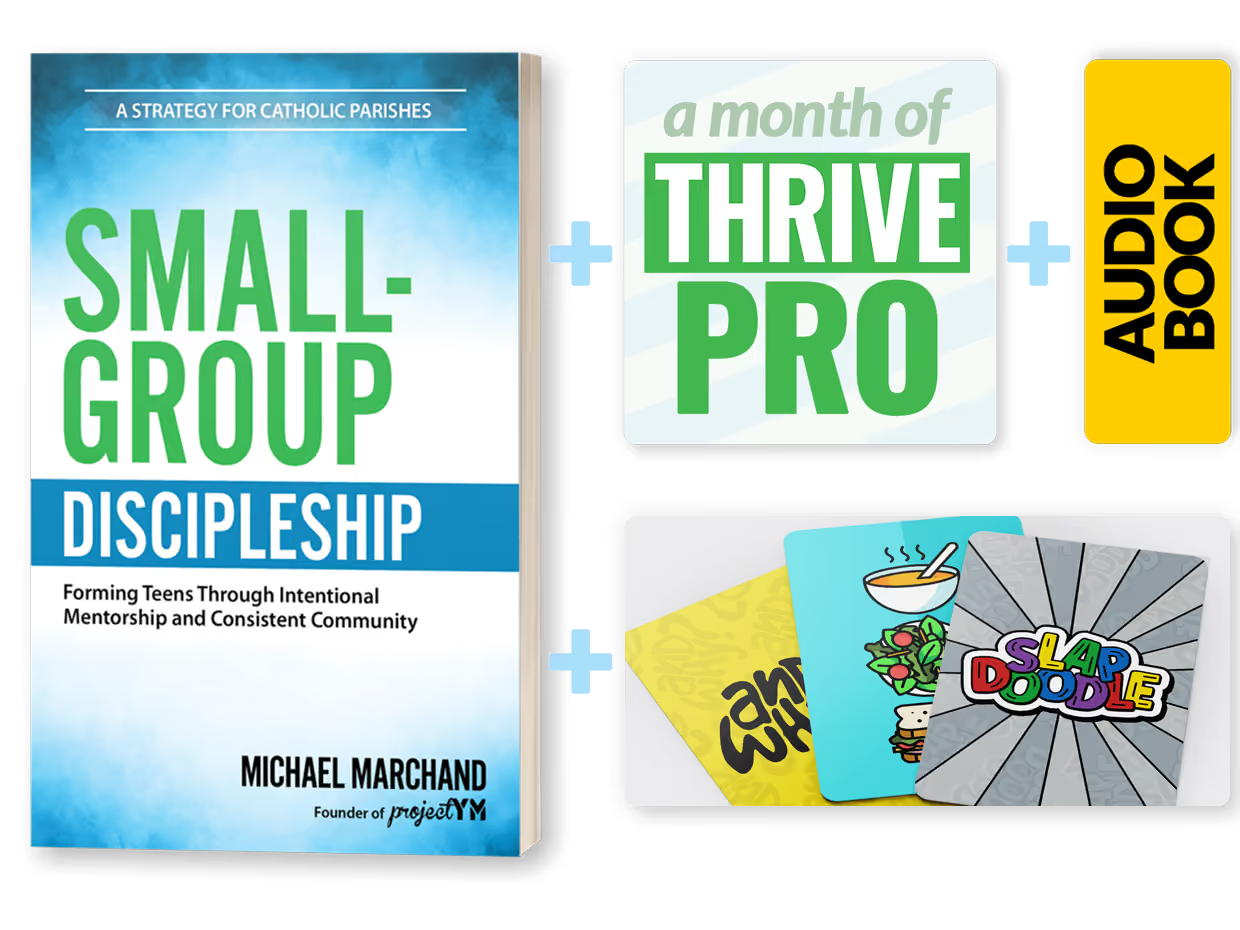
THE BOOK

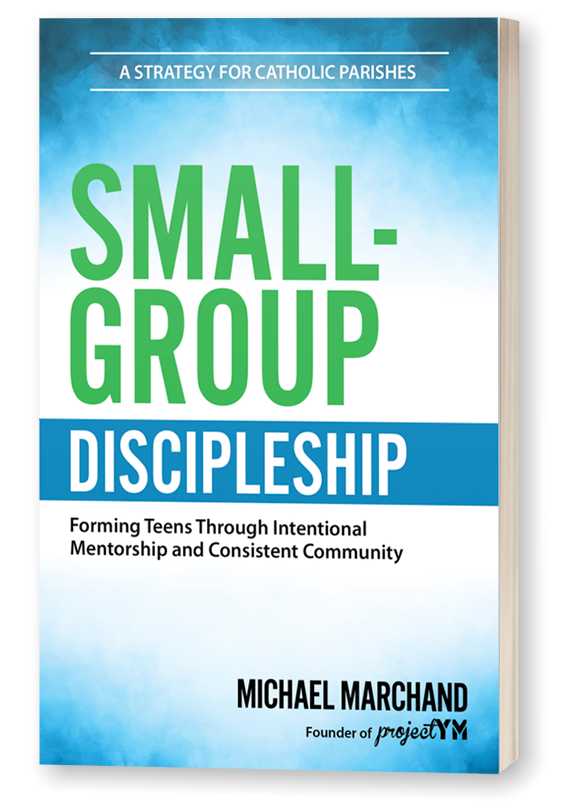
Small Group Discipleship

By Michael Marchand

Coming soon from Ave Maria Press.

FIND OUT MORE

IN PERSON

Intentional Small Group Masterclass

Join us this Fall for a four day, in-person training event at our the ProjectYM Mission Base in Chattanooga, TN.

GET THE DETAILS

Be the First to Know
About the New Book

24+1=6

Made by Michael Marchand